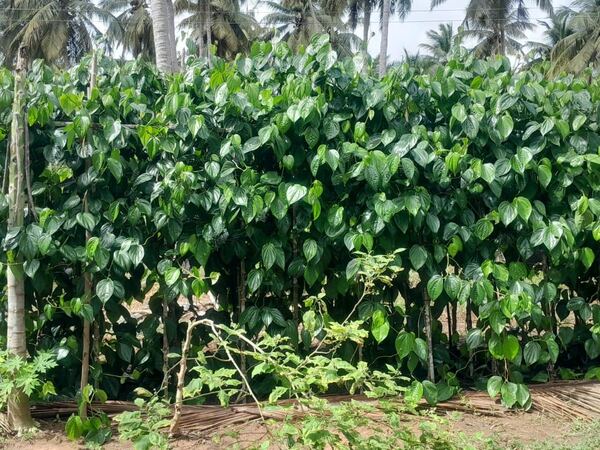
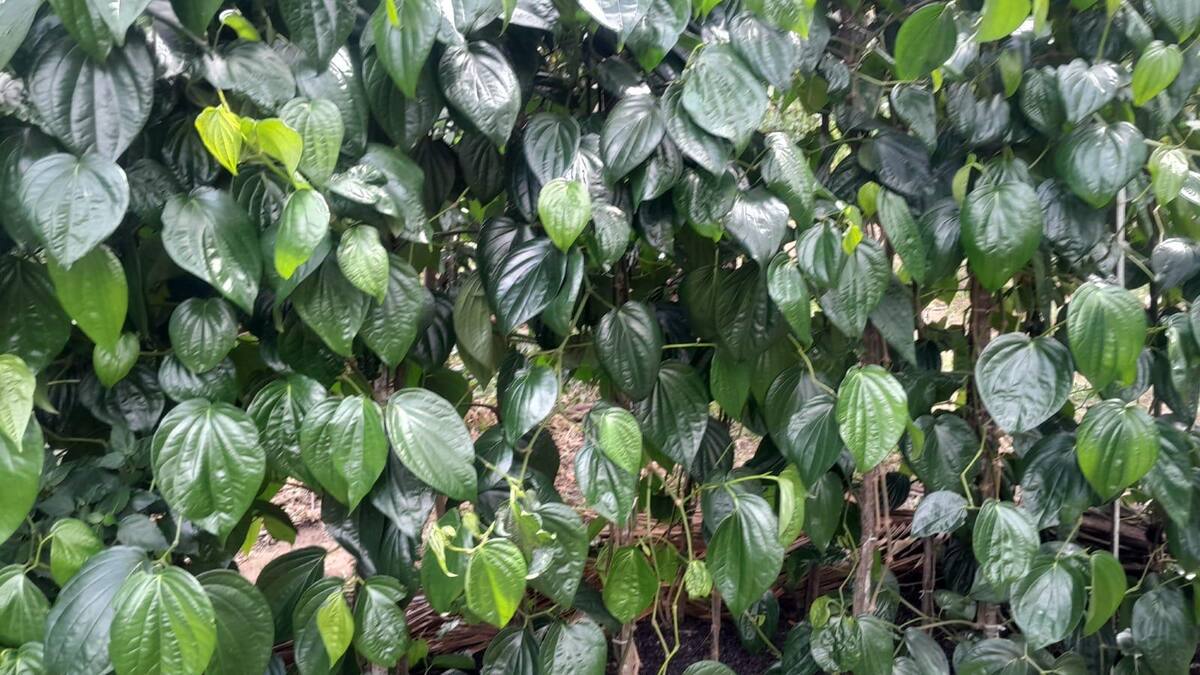
Mature Kalu bulath betel vines trained on their supports, the canopy dense with deep dark green leaves.

Sri Lanka Piper betle L. HS 1404.90

Export-grade Kalu bulath betel leaves, direct from Sri Lankan farms.

Sri Lankan betel leaf is listed in neither annex of Regulation (EU) 2019/1793. Betel leaf from India, Bangladesh and Thailand is, and that listing means a pre-export official certificate, an accredited laboratory result with every consignment, and a raised check rate at the border.

  • HS 1404.90
  • Phytosanitary certified
  • 20 cm+ leaf grade
  • Air freight from CMB

Regulatory position

Where the leaf comes from decides how the consignment is treated at the border.

EU and GB import rules do not treat all betel leaf the same. Origin sets the control regime before anyone opens a carton. Below is the position for the three origins that matter to this trade, with the instrument that sets it. Check it against your own customs broker before you buy from anyone, including us.

EU and GB import status, by origin of the leaf

Bangladesh

Annex II · 50% checks

Listed in Annex II for Salmonella. Every consignment needs an official certificate and an accredited laboratory result issued before it leaves, and identity and physical checks run at 50% on arrival.

Imports were prohibited outright from 2014 under Decision 2014/88/EU. That decision was repealed in 2020 and the entry moved into Annex II in April 2021, so the ban is history rather than current law.

Regulation (EU) 2019/1793, Annex IISpecial conditions on entry, plus identity and physical checks on 50% of consignments.

India

Annex II · 10% checks

Listed in Annex II for Salmonella under CN code ex 1404 90 00, TARIC subdivision 10. The same special conditions apply: an official certificate from the competent authority and an ISO/IEC 17025 accredited laboratory result with every consignment, plus identity and physical checks on 10%.

Thailand is listed on the same basis for the same hazard.

Regulation (EU) 2019/1793, Annex IISpecial conditions on entry, plus identity and physical checks on 10% of consignments.

Sri Lanka

Not listed

Betel leaf from Sri Lanka appears in neither Annex I nor Annex II. No pre-export official certificate under that regulation, no mandatory laboratory analysis per consignment, no raised check frequency. The standard border procedure for fresh plant products applies.

Sri Lanka is listed for two other commodities, dried Capsicum peppers and mukunuwenna. The absence of betel leaf is a specific reading of the list, not a claim that the country is absent from it.

Regulation (EU) 2019/1793No betel leaf entry for Sri Lanka in either annex. Great Britain mirrors the position under the assimilated regulation.

Position as at [[REG_REVIEW_DATE]], read against Regulation (EU) 2019/1793 as amended to Implementing Regulation (EU) 2026/194, and against the Food Standards Agency list of foodstuffs with GB import restrictions. The Commission reviews these annexes roughly every six months. Verify the current position with your own broker or competent authority before contracting.
What that means for your consignment

An Annex II listing is not only a percentage. It is a pre-export regime: sampling and analysis by the competent authority in the country of origin, an accredited laboratory, an identification code on every package, and an official certificate that expires. Sri Lankan betel leaf carries none of that, so a consignment is not held while a certificate is chased and is not pre-selected for physical examination on origin grounds.

Serendib Exports supplies a phytosanitary certificate, certificate of origin, packing list, commercial invoice and air waybill with every shipment. Accredited Salmonella and E. coli testing can be arranged per consignment on request, which is the same evidence an Annex II origin is compelled to produce, offered because you asked for it rather than because a regulator did.

See the full documentation list

The cultivar

Kalu bulath: the thick, dark-leaf betel grown for export.

Kalu bulath is the dark-leaf cultivar Sri Lankan growers hold back for export. The leaf is thicker than the common green types, the colour is deeper, and the pungency is higher.

Thickness is what gives the leaf its keeping quality. A thicker lamina loses water more slowly, so the leaf still has its colour and its snap after air freight, ground handling and customs clearance. That is the difference between a consignment your buyer accepts and one you discount.

We work with one cultivar. That is deliberate. A packing house grading four cultivars cannot hold one standard across all of them, and the buyer is the person who finds out.

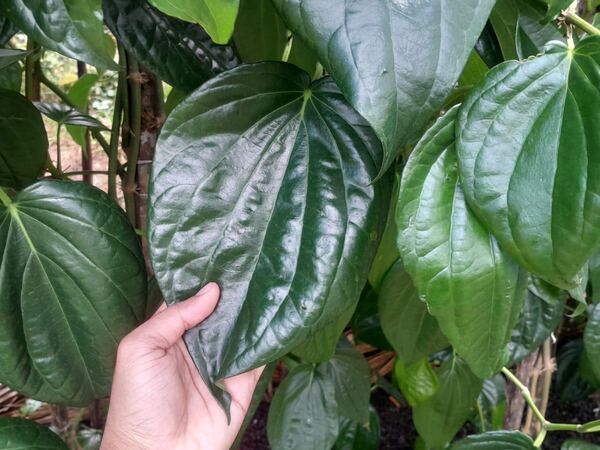
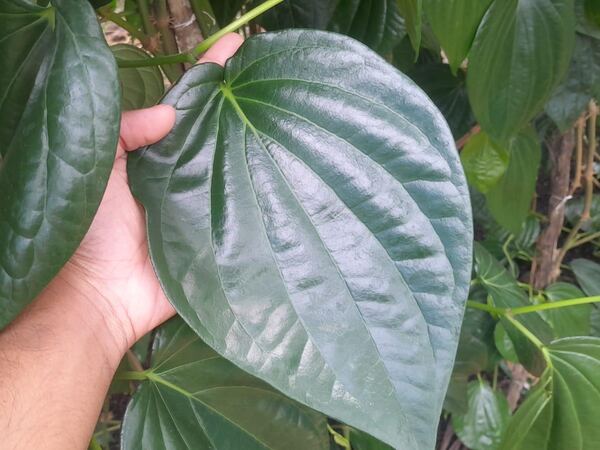
A cut Kalu bulath leaf held in one hand, filling the palm, the surface glossy and the veining raised.
Deep dark green, well matured, thick in the hand. Colour uniformity is graded against a reference leaf at packing.
A grower holding a mature betel leaf from underneath while it is still attached to the vine, with the canopy behind it.
Maturity is judged on the vine before anything is cut. Immature and over-mature leaves are left where they are.
Rows of betel vines trained on timber supports under a coconut canopy, with shade netting along one edge of the plot.
Vines trained on supports under coconut shade. Grown on own and contracted plots, with each intake recorded against its grower and plot.

Where it is grown

Commercial export-grade Kalu bulath comes from five districts: Kurunegala, Gampaha, Kegalle, Kalutara and Colombo. Serendib Exports sources from its own farms and from contracted farms in these districts, which is what lets us trace a grade problem back to a plot instead of to a market floor.

Sri Lanka is the world’s largest exporter of betel leaves by shipment volume. The principal destination markets are Pakistan, the United Kingdom and continental Europe.

Specification

The numbers we grade against.

This is the standard every consignment is measured to before it is packed. If a figure below does not suit your market, tell us and we will quote to your specification instead of pretending ours is the only one.

Export grade, Kalu bulath fresh betel leaf
Botanical namePiper betle L.
CultivarKalu bulath, the thick dark-leaf type
Minimum leaf length20 cm
Minimum leaf width15 cm
ColourDeep dark green, uniform across the bundle
MaturityWell matured. Immature and over-mature leaves are rejected at grading
Stem retained2.5 to 3 cm
Leaf characterThick lamina, high pungency, superior keeping quality
Leaves per bundle[[LEAVES_PER_BUNDLE]]
Bundles per carton[[BUNDLES_PER_CARTON]]
Net weight per carton[[CARTON_NET_WEIGHT]]
Carton dimensions[[CARTON_DIMENSIONS]]
Harvest to airport[[HARVEST_TO_AIRPORT_HOURS]]
Transport temperature[[TEMPERATURE_RANGE]]
HS code1404.90. UK and EU commodity code 1404 9000 10, betel leaves (Piper betle L.)
Port of loadingColombo, Bandaranaike International Airport (CMB)
ModeAir freight only

Carton configuration can be adjusted to buyer requirement. Tell us your pallet, ULD or shelf constraint and we will quote to it rather than asking you to work around ours.

Download spec sheet (PDF)

Farm to freight

Six steps, and we can name the grower at step one.

Traceability is not a claim, it is a record. Every consignment can be walked back from the carton to the plot it was cut on.

  1. Cultivation

    Vines on own and contracted plots in Kurunegala, Gampaha, Kegalle, Kalutara and Colombo. Grower and plot recorded at intake.

  2. Selective hand harvest

    Only well-matured leaves are cut, with 2.5 to 3 cm of stem. Immature and blemished leaves stay on the vine.

  3. Grading to export spec

    Measured against the 20 cm length and 15 cm width minimums, checked for colour uniformity, bundled to a fixed count.

  4. Pre-cooling

    Field heat is removed before packing, so the leaf enters the carton at transport temperature rather than at ambient.

  5. Packing and documentation

    Packed to the agreed carton configuration. Phytosanitary application, certificate of origin, packing list and invoice prepared with the consignment.

  6. Air freight from Colombo

    Presented for mandatory pre-export inspection by the National Plant Quarantine Service at Bandaranaike International Airport, then uplifted on the booked flight.

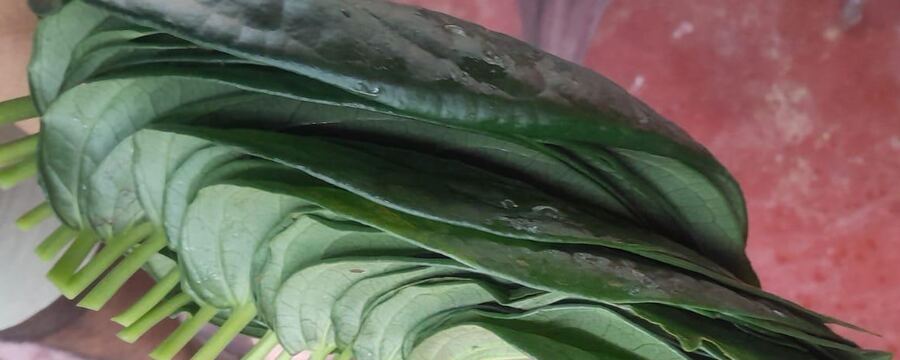
A graded bundle of betel leaves held in one hand, every stem cut to the same length and aligned along the edge of the bundle.
Step 3 photographed. Every stem in the bundle is cut to the same length and aligned, which is what makes a fixed leaf count countable at your end and lets a buyer handle the bundle without bruising the lamina.

Markets served

Four lanes, two very different kinds of buyer.

These are the markets we ship to and the lanes we can book. We do not publish customer names, and you should be wary of any exporter who publishes yours.

United Kingdom and Europe

Documentation-led buyers. Spec conformity, phytosanitary paperwork and lab results on request matter more than a small price difference. Lanes available to London, Paris, Frankfurt and Milan.

Pakistan

Volume-led buyers in the Karachi and Lahore markets. Grade consistency across repeat shipments and predictable weekly uplift are what get judged. We answer WhatsApp in English and Urdu.

Gulf states

Steady demand through the South Asian retail trade. Short flight times from Colombo suit fresh leaf, and consignment sizes tend to sit between the European and Pakistani extremes.

Maldives

A short-haul lane with small, frequent consignments. Suited to buyers who want a fixed weekly carton count rather than bulk shipments.

Compliance and documentation

What we hold, and what we do not hold yet.

Two lists. The first is what arrives with every consignment because Sri Lankan export law and normal trade practice require it. The second is what we have not yet certified. We will not put a logo on this page for a certificate we do not hold.

Supplied with every shipment

Documents in the pack

  • Phytosanitary certificate, issued by the National Plant Quarantine Service after the mandatory pre-export inspection at Bandaranaike International Airport.
  • Certificate of origin
  • Packing list with carton count, net and gross weight
  • Commercial invoice
  • Air waybill

Exporters of plant products from Sri Lanka must be registered with the National Plant Quarantine Service of the Department of Agriculture, and every consignment requires a phytosanitary certificate issued after inspection. The Sri Lanka Export Development Board is the national export authority.

NPQS registration [[NPQS_REGISTRATION_NUMBER]] · EDB registration [[EDB_REGISTRATION_NUMBER]]

Testing and certification

Microbiological testing, and an honest note on certificates

Available per consignment on request: accredited Salmonella and E. coli testing, carried out by an accredited laboratory, with the report issued against the consignment. You specify the parameters and the sampling plan. Cost is quoted per consignment rather than absorbed into a headline price.


Not yet held: Serendib Exports does not currently publish HACCP, ISO 22000 or GlobalG.A.P. certification, and we will not display a badge for one. Ask us where each stands and we will tell you the position in writing. If a certificate is a condition of your purchase order, say so at the quote stage rather than at the first shipment.

Why Serendib Exports

Six things you can hold us to.

Each of these is checkable. If one of them stops being true, you will find out on the first shipment, which is the point of writing them down.

Direct farm control

Own farms and contracted farms, with intake recorded by grower and plot. We do not buy anonymous lots off the open market and re-badge them.

One cultivar only

Kalu bulath, and nothing else. A single-cultivar packing house holds one grade standard, so the leaf you approve in a sample is the leaf that arrives in week nine.

Documentation first

Papers are prepared with the consignment, not chased after it has left. The phytosanitary certificate follows the mandatory pre-export inspection at Colombo.

Cold chain discipline

Field heat removed before packing, and the leaf held at transport temperature through to uplift. Most arrival quality complaints start as a warm carton on a loading bay.

English and Urdu

The same person answers WhatsApp and email, in either language, during Sri Lankan business hours and well outside them. No ticket queue, no account handover.

Trial consignments accepted

Order sizes are flexible, including a single trial lot. Test the leaf and the paperwork on something small before you commit to a weekly programme.

Buyer references

This section is empty on purpose.

We will publish buyer references here when buyers have agreed in writing to be named. Nothing on this page is invented, and that includes this part of it.

If you want a trade reference before contracting, ask for one and we will put it in writing.

Ask for a reference

Procurement questions

The ten questions buyers actually ask first.

Does Sri Lankan betel leaf need a Salmonella certificate to enter the EU or GB?

Not under Regulation (EU) 2019/1793. Betel leaf from Sri Lanka is listed in neither Annex I nor Annex II of that regulation, so there is no mandatory pre-export official certificate and no mandatory laboratory analysis per consignment. Betel leaf from India, Bangladesh and Thailand is listed in Annex II and does carry those conditions.

Accredited Salmonella and E. coli testing is still available per consignment on request, and several buyers take it as a matter of their own due diligence rather than because a regulator requires it. Verify the current listing with your broker before contracting.

What is your minimum order quantity?

Our standard minimum is [[MOQ]]. Sample and trial consignments below that are accepted and priced separately, so you can assess the leaf and the paperwork before committing to a programme.

How long from confirmed order to airport?

[[LEAD_TIME_DAYS]] from a confirmed order to uplift, subject to flight availability on your lane. Harvest is scheduled against the flight rather than the other way round, so the leaf is cut as close to departure as the inspection schedule allows.

What is the shelf life, and how should the leaf be handled on arrival?

Fresh betel leaf is perishable and its life depends on your lane, your clearance time and your storage, so we do not publish a single shelf-life figure. Any exporter quoting you one number for every destination is guessing.

Hold the cartons at the agreed transport temperature, keep free moisture off the leaf surface, and move the consignment out of the airport cold store promptly. Written handling guidance for your specific lane is issued with the first shipment.

What payment terms do you offer?

First orders are on advance telegraphic transfer, or against a confirmed irrevocable letter of credit. Terms can be reviewed once there is a shipment history between us. We would rather agree that plainly at the start than renegotiate it while a consignment sits on a tarmac.

Which Incoterms do you quote?

FOB Colombo (CMB) as standard. CFR and CIF are available to a named destination airport. Ex Works is available if you appoint your own forwarder in Colombo. Tell us which you work on and the quote will come back on that basis.

Which documents accompany a shipment?

Phytosanitary certificate, certificate of origin, packing list, commercial invoice and air waybill. Accredited Salmonella and E. coli test reports can be added per consignment on request.

Can I get a sample before ordering?

Yes. Sample consignments are available, charged at cost plus air freight. On most lanes the freight is the larger part of that figure, so give us your destination airport and we will quote the exact amount rather than a range.

How is the leaf packed?

Bundled to a fixed leaf count and packed into export cartons: [[LEAVES_PER_BUNDLE]] per bundle, [[BUNDLES_PER_CARTON]] bundles per carton, [[CARTON_NET_WEIGHT]] net, carton [[CARTON_DIMENSIONS]]. Configuration can be changed to your requirement.

Do you ship by air or by sea?

Air freight only, from Bandaranaike International Airport in Colombo. Fresh betel leaf does not survive a sea voyage in saleable condition. An exporter offering you sea freight on fresh leaf is either shipping a dried product or planning for arrival losses that you will end up paying for.

How do you keep leaf grade consistent between shipments?

One cultivar, a written grade standard, grading against measured minimums rather than by eye alone, and the same graders on every consignment. Intake is recorded by grower and plot, so if a grade problem appears in week nine we can trace it to a farm and correct it there instead of arguing about it with you.

Request a quotation

Tell us the airport and the volume. You get a price against it.

Eight fields. The reply comes back on your Incoterm, to your named airport, with the specification attached, from the person who will handle the shipment.

Please give us a name to reply to.

Please give the importing company name.

Please choose the destination country.

IATA code or name. This is what the freight quote is built on.

Please name the destination airport or port.

Please check the email address.

Include the country code if you would rather we replied there.

Please pick the closest band. An estimate is fine.

  • Response within 24 hours
  • Phytosanitary certificate with every shipment

Form not working, or you would rather write directly? Email [[EMAIL]].